
Five Simple Steps To Analyze Potential Deals & Acquire Rental Properties Like A Pro!
The ONE Metric That Matters Most To Accelerate Wealth Creation

In Today’s Issue:
🔎INSIDER INSIGHTS: Start With Your Real Estate “BUY BOX”
🤿A DEEPER DIVE: Five Simple Steps To Analyze Potential Deals & Acquire Rental Properties Like A Pro
📝THAT’S A WRAP: Tell Us What You Want To Learn Next
Start With Your Real Estate “Buy Box”
As a Real Estate Collaborator, you’ll need a real estate buy box to win the wealth game.
A real estate buy box is a defined set of specific criteria—including location, property type, price range, and ROI metrics—that investors use to filter potential acquisitions. It acts as a strategic, non-negotiable checklist to narrow down options, avoid emotional, impulsive, or unprofitable acquisitions, and streamline the search process.
Simply put, your buy box is your filtering system to keep you from hurting yourself and your collaborative partners.
My Current Buy Box (residential)
Feel free to use it “as is” or modify it to create your own personalied buy box:
Fix & Flip:
Location(s): Texas & Memphis, TN
Minimum Population: 30,000
Max Price Point: below the median housing price in the area
Bedrooms: 3+, Bathrooms: 1+, Minimum Square Footage: 1000 s.f.
Offer Price Formula:
After Repair Value (ARV) x 70% to 75% - Repairs = Maximum Allowable Offer (MAO)
ARV < $200,000 = 70% minus repairs
ARV $200,000 - $275,000 = 72% minus repairs
ARV > $275,000 = 75% minus repairs
Minimum Acceptable Profit Potential: 10% of ARV or $20,000, whichever is higher
Fix & Rent:
75% - Repairs = Max Allowable Offer (MAO)
Cash on Cash (COC) ROI is 5% or higher
Equity Multiple equal to or greater than 1.0
SPECIAL NOTE:
Rental/Sales Comparables: at least 2 within the previous 3 to 6 months - within a 1-mile radius (preferably same neighborhood)
Approval required for the following:
backed to commercial, has a swimming pool, on a main or busy street, above 2500 s.f. of living area, or less than 2 sales comparables available
Pro Tip: Fix & Flip to generate operating capital. Fix & Rent to accelerate wealth creation.
Five Simple Steps To Analyze Potential Deals & Acquire Rental Properties Like A Pro
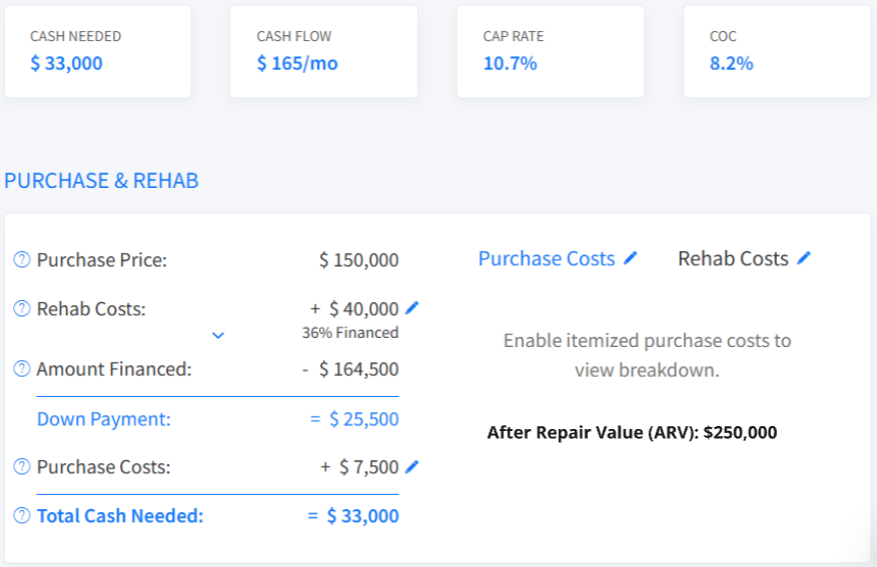
Six Numbers To Optimize When Accelerating Wealth Creation:
Cash Needed: The total amount of cash you will need to purchase and rehab a property. Intelligent use of leverage comes into play here.
Rehab Costs: Expenses that you expect to pay after purchasing a property to improve its condition or perform repairs. Examples include: new paint, new appliances, new carpet, electrical repairs, landscaping and cleaning. You can choose to finance all or part of the rehab costs when analyzing properties.
Cash Flow: The total net amount you will receive from a rental property as income. Cash flow accounts for all sources of income and all expenses, including loan payments if you are using financing (income - expenses).
Cash On Cash Return (COC): A rate of return of a rental property based on comparing the yearly cash flow to the total invested cash. The cash on cash return represents the yearly return or yield you will receive on your invested capital (yearly net cash flow / total invested cash).
After Repair Value (ARV): The estimated market value of a property after its rehab is complete. If no repairs are necessary, the after repair value is the same as the current market value.
Equity Multiple: A ratio that shows the total rate of return of a rental property based on comparing the total profit from your investment to the total invested cash.
For example, if your total invested cash is $30,000 and your total profit is $30,000 - your equity multiple is 1.0 [$30,000 (total profit) / $30,000 (invested cash) = 1.0]
Don’t Worry. You Don’t Have To Be Good At Math!
Fortunately for us, there are tools available in the marketplace that will do all the heavy lifting for us when it comes to running the numbers in real estate investing. We have access to prebuilt spreadsheets and software specifically designed to calculate the numbers—exactly the way we need to see them.
Any tool can work just fine but there is one real estate investing software in particular that I like called DealCheck.
Use the link below to sign up for the free version of DealCheck and 20% off the paid version.
Five Simple Steps:
Step 1: Determine the after repair value (ARV)
Step 2: Do a quick preliminary estimate of repairs
Step 3: Utilize your buy box to determine max allowable offer (MAO)
Step 4: Make an offer to acquire the property
Step 5: Collaborate & make unlimited acquisitions
STEP 1: Determine the After Repair Value (ARV)…
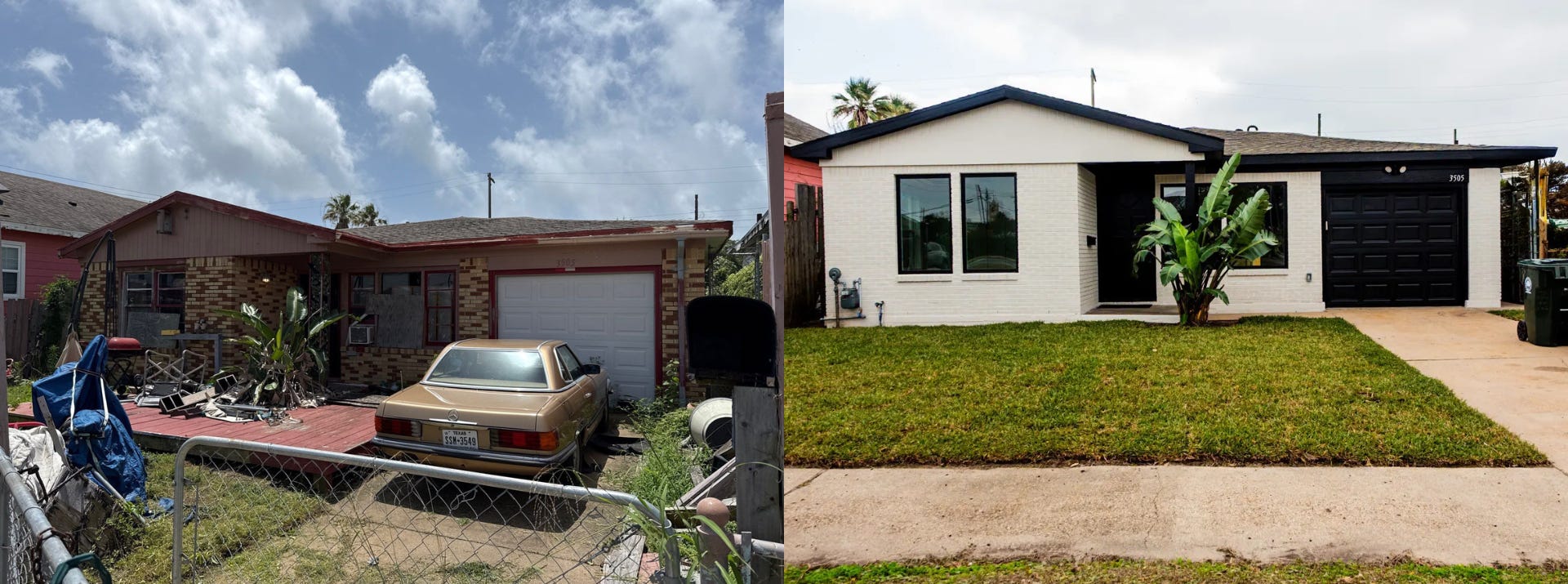
Think of the After Repair Value (ARV) as a “prediction.” It is your best guess of what a house will sell for after it has been fully fixed up and looks brand new.
As an investor, you need this number to make sure you don’t spend more on the house and repairs than the house is actually worth.
Here is a simple 4-step guide to finding the ARV:
1. Find the “Comps”
“Comps” is short for comparable sales. You want to find 3 to 5 houses that have sold recently (in the last 6 months) that are very similar to your property. Look for houses that:
Are in the same neighborhood (within 1 mile).
Have a similar square footage (within 10% to 20% of yours).
Have the same number of bedrooms and bathrooms.
Have the same number of stories (i.e. 1 or 2-story)
Most importantly: Are already renovated and in tip-top shape.
2. Compare the Details
Line up your property next to the comps you found. If your house has a 2-car garage but the comp only has a 1-car garage, your house might be worth a little more. If the comp is on a quiet street and yours is on a loud highway, your house might be worth a little less.
3. Calculate the Average Price per Square Foot
This is a quick way to get a baseline.
Take the sale price of a comp and divide it by its square footage.
Do this for all your comps and find the average.
Example: If the average price in the area is $150 per square foot and your house is 1,000 square feet, your ARV might be around $150,000.
4. Set Your Final Number
Look at the sales prices of those renovated comps again. If three beautiful, fixed-up houses in the neighborhood all sold for exactly $200,000, then your ARV is likely $200,000. Don’t be too optimistic—be realistic based on what buyers have actually paid!
Pro Tip: Always look at “Sold” listings, not “Active” listings. People can ask for any price they want, but the “Sold” price tells you what the market is actually willing to pay.
STEP 2: Do a Quick Preliminary Estimate of Repairs…
Any investor would agree that having an accurate rehab budget can make or break a deal. In fact, the rehab budget has been responsible for breaking far more deals than it has made.
So take this step very seriously.
At this point, you don’t have the property under contract so it’s important that you avoid wasting needless time on the repair estimate. Consequently you will need to be quick and efficient by using a formula like the following…
Quick Repair Estimate Formula:
Light Rehab - $20/sf
Medium Rehab - $30/sf
Heavy Rehab - $40/sf
Subtract an additional $7,500 for each major repair item (Foundation, Roof, HVAC, Electrical, Plumbing, or Windows)
Example: What is the repair estimate?
ARV: $195,000
Square Footage: 1200
Asking Price: $120,000
You visit the site or review the pictures and determine a light rehab is required along with HVAC installation…
1200 x $20/sf (light rehab) = $24,000 + $7,500 (HVAC) = $31,500
Repair estimate is $31,500
This formula can be used by viewing photos of a property enabling you to be both quick and efficient.
After you have the property under contract with a reasonable inpection period, you can send your contractor out to get a concrete repair estimate to validate or invalidate your preliminary estimate. If the concrete estimate comes in higher, you can renegotiate to make the numbers work. Otherwise, walk away and live to fight another day.
STEP 3: Utilize your buy box to determine max allowable offer (MAO)
Now that you have the ARV and your preliminary repair estimate, all you need do is plug those two numbers into your MAO formula that is based on your buy box.
We’ll continue using the previous example while utilizing my buy box criteria…
ARV: $195,000
Square Footage: 1200
Asking Price: $120,000
Preliminary Repair Estimate: $31,500
ARV x 70% (<$200,000) minus Repair Estimate = MAO
$195,000 x 70% = $136,000 minus $31,500 = $105,000
Maximum Allowable Offer (MAO) = $105,000
STEP 4: Make an offer to acquire the property
You have your MAO at this point and it’s time to make the offer.
Be sure to make the offer because, oftentimes, the only way to truly uncover the seller’s motivation is with an offer - especially off market properties (not listed on a multiple listing service).
Remember…
NO Offers = NO Deals = NO Revenue!
Need I say more about the importance of making the offer?
STEP 5: Collaborate & make unlimited acquisitions
The key word here is “Collaborate.”
There is only so much you can do on your own. However, as a Real Estate Collaborator helping other investors accelerate wealth creation, there is no limit to the number of acquisitions you can orchestrate. Whether you choose to make one or twenty yearly acquistions - the process remain the same.

The ONE Number That Matters Most To Accelerate Wealth Creation
When it comes to accelerating wealth creation there is ONE number you will need to pay close attention to up front…
Equity Multiple
This strategy in our playbook is about forced appreciation. It involves buying property at a deep discount usually because it’s in poor condition and fixing it up to increase the value. Thereby forcing the appreciation instead of depending on the market.
If you recall, my buy box requires that we purchase property at 70 to 75% of ARV. That’s because at least 10% of that 25 to 30% discount is typically due to the appreciation forced into existence from fixing it up.
Pro Tip: the focus of this particular wealth strategy is on forcing appreciation and then selling or refinancing to liquidate that equity and acquire more doors (i.e. small apartment) at which time the focus shifts to maximizing cash flow.
Are You Ready?
Let’s GO!
Stay tuned for more details in upcoming issues, live streams, and free workshops!
That’s A Wrap: Tell Us What You Want To Learn Next!
Was this useful (be brutally honest)? Have ideas on what I should publish next? Tap the poll or reply to this email. I read every response.